
Message match: why your landing page has to continue your ad
Hookpair team. Updated
Someone stops scrolling because your ad promised something specific. One second after the click, your landing page either confirms that promise or makes them look for it. Message match is the name for the first case. When it breaks, you pay for the click and lose the visitor before they read a word of your offer.
What message match means
Message match is how closely the first screen of a landing page repeats what the ad said and showed: the same promise, the same product or variant, the same offer, in a look the visitor recognises. It is not about copying the ad word for word. It is about the visitor never having to wonder whether they landed in the right place.
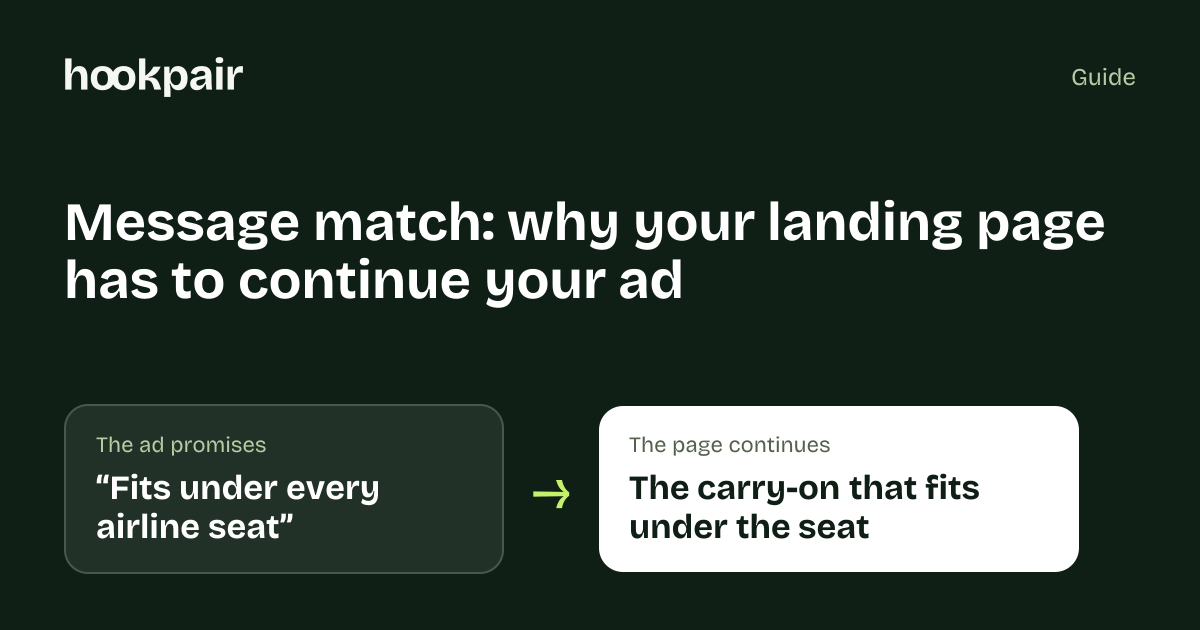
Think of it as a conversation. The ad starts it ("Fits under every airline seat"). The page should answer in the same topic ("The 40-litre carry-on that fits under the seat"), not switch to another one ("Shop our backpack collection").
The five parts of a match
When we audit an ad against its page, the gaps almost always fall into one of five places:
- Promise: the benefit the ad leads with appears as the headline or right under it.
- Product: the page opens on the exact product and variant shown in the ad, not a collection.
- Offer: a discount, bundle or free shipping from the ad is visible without scrolling, with the same numbers.
- Proof: a claim in the ad ("5,000 reviews", "dermatologist tested") is backed on the page, near the claim.
- Look: the main image, colours and tone feel like the same brand moment as the creative.
A page can be beautiful and still miss three of these. That is why a design review alone rarely finds message-match problems: you have to put the ad next to the page.
How to check your own match in five minutes
- 1Open the ad and the landing page side by side, on a phone, because that is where most Meta clicks happen.
- 2Write down the ad's main promise in one sentence and its offer, if any.
- 3Look only at the page's first screen. Can you find that sentence, or its meaning, there? Is the offer there with the same numbers?
- 4Check that the product and variant are the ones in the ad.
- 5Scroll once. Is every claim from the ad supported somewhere on the page?
Anything you could not find is a gap. Write it down with the exact line from the ad. That list is your test plan. If you want this done for you with every finding quoted from both sides, a free message-match audit does exactly this check.
The smallest changes that usually fix it
- Rewrite the headline so it repeats the ad's promise in the page's voice.
- Link the ad to the product page of the advertised variant, or to a page built for that ad, instead of a collection.
- Put the ad's offer above the fold, in the same wording and numbers.
- Move the proof for the ad's main claim next to the headline.
- Use the ad's hero image, or the same product shot, as the page's first image.
Change one of these at a time if you want to learn which one mattered. If the gap is obvious and the fix is cheap, just fix it.
An example
- Ad promise
- Fits under every airline seat. 20% off your first order this week.
- Page headline
- The everyday backpack, designed in Berlin.
- Gap
- Size promise missing, discount missing, page talks about everyday use instead of flying.
- Smallest fix
- Headline: "The carry-on that fits under the seat." Offer bar with the 20% code. Dimensions next to the hero image.
Notice that nothing about the product changed. The page just answers the question the ad raised.
Free tool: Message match check · Compare the ad's hook with the landing page headline: which words and offer numbers carry over, and which disappear after the click.
Questions
Is message match the same as landing page optimisation?
It is one part of it, and usually the first one to check for paid traffic. General optimisation looks at the page alone; message match looks at the page in relation to the ad that sent the visitor.
Do I need a separate landing page for every ad?
No. Group ads by their main promise. One page per promise is usually enough, and sometimes a better headline on the product page is all you need.
Does message match matter for Google ads too?
Yes. The principle is the same; for search ads the 'promise' is often the keyword and the ad headline.