
Product page or landing page for your Meta ads?
Hookpair team. Updated
Shopify stores usually start by sending ads to product pages. At some point someone suggests a dedicated landing page. Both can work; the question is which one continues the ad better for the effort it takes.
When the product page is enough
- The ad shows one product and its main benefit is already the product page's headline.
- The product is familiar and the price is the main decision.
- You can link straight to the right variant (most themes support a variant parameter in the URL).
In these cases, improving the product page's first screen helps every ad that points to it.
When a dedicated page pays off
- The ad sells an angle the product page doesn't cover, such as a use case, a problem or a gift idea.
- You run several ad angles for the same product and each needs its own headline and proof.
- The product needs explaining: new category, higher price, a claim that needs evidence.
- You want to test a bundle or offer without changing the product page for everyone.
A simple way to decide
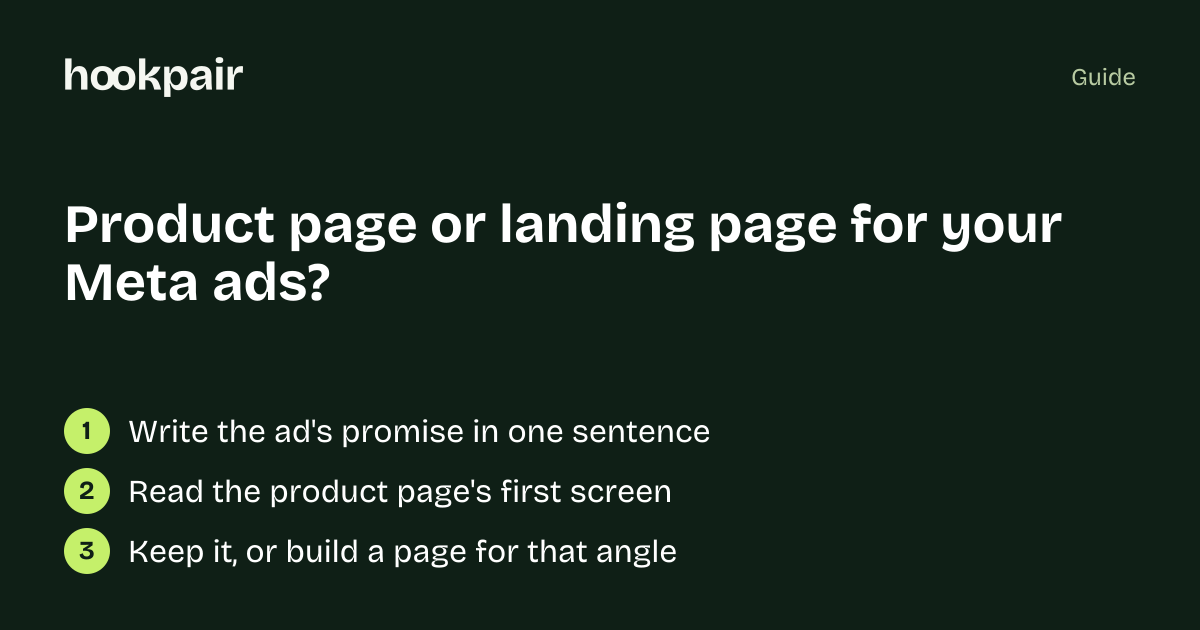
- 1Write the ad's promise in one sentence.
- 2Read the product page's first screen. Does it say that sentence, or clearly mean it?
- 3If yes, keep the product page and tighten it. If no, and the gap can't be closed without hurting the page for other visitors, build a page for that angle.
Hookpair drafts that angle page from the audit, in your brand, as HTML you can bring into Shopify, GemPages or Funnelish. See how the audit works.
Free tool: Message match check · Compare the ad's hook with the landing page headline: which words and offer numbers carry over, and which disappear after the click.
Questions
Will a separate landing page hurt my SEO?
Pages built for paid traffic are usually set to noindex, so they don't compete with your product pages in search.
Can I keep the cart and checkout of my shop?
Yes. Buttons on a landing page can add the product to the shop's cart or link to the product, so checkout stays in your shop.